SAMPLE SITE ONLY
This site is intended as a sampler for visitors. Volume I, Chapter 3, offers a preview of what every chapter will contain for those who purchase the books and the Roadmaps. See the order forms for purchasing details.

User login


Welcome
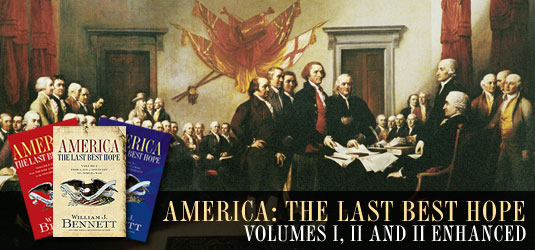
Complete American History Curriculum for a New Century of American Youth
Textbooks by former Secretary of Education Dr. William J. Bennett and Online Supplements for Social Studies and History Education Including Advanced Placement U.S. History
Once upon a time, not too long ago, we understood what our history was, we recognized it as glory and romance—the very words etched into the top of our National Archives, describing what the building underneath contains and protects. The story of America is a great story. In fact, it is the greatest political story ever told. We have prevented epidemics, improved the conditions of mankind, and saved other countries. We have fought wars for ourselves as well as others, we have liberated, and we have become not only a shining city on a hill, but a place of refuge since our beginnings. America is not just the story of great leaders; it is the story of a great people who wisely choose how to save themselves and others, how to correct wrongs, and how to preserve what is still the greatest nation in the history of the world. If we dedicate ourselves to studying our history, we will see what our Founders saw we could be, what foreigners who came here saw all along, and what we ourselves can—even today—see each day. Remember Abraham Lincoln's words in 1862: "We hold the power, and bear the responsibility. We shall nobly save, or meanly lose, the last best hope of earth." Join author William J. Bennett and students and teachers across the country as we read America: The Last Best Hope; the story of America written as drama, romance, comedy, mystery, action, tragedy, and triumph. There is no time like the present to get excited and knowledgeable about the past. We look forward to your participation and ideas.
To view our program overview video
To order sample materials for your school, click here.