SAMPLE SITE ONLY
This site is intended as a sampler for visitors. Volume I, Chapter 3, offers a preview of what every chapter will contain for those who purchase the books and the Roadmaps. See the order forms for purchasing details.

Syllabus

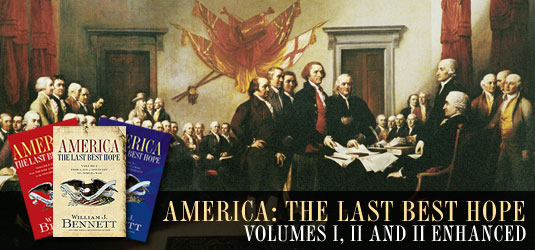
Sample Syllabus for America: The Last Best Hope, By William J. Bennett One-Year U.S. History Course Using Volume II Enhanced and Covering 1877 to the Present

The following syllabus is meant only as a suggested timeline for a teacher using William J. Bennett’s America: The Last Best Hope.  Along with the topics suggested, teachers are reminded that the Roadmap to Last Best Hope includes lesson plans, plays, debates, Podcasts by Dr. Bennett, maps and map exercises, PowerPoint presentations, and suggested resources for further student learning and exploration (films, books, primary sources, websites).  Teachers and students will also find timelines, glossaries, key historical points and chapter summaries that can be used as tools to deepen students’ understanding of the material.  Teachers will want to pick and choose from the ample resources on the Roadmap to find activities and tools that best meet the needs of their class. 

But despite the quality and variety of the resources included in the Roadmap, the members of Team HOPE, who created the Roadmap, believe that the strength of Last Best Hope comes from the fact that unlike virtually any textbook, it is a book students will actually want to read.  Teachers should begin with this premise – that students will be engaged by Bennett’s narrative.  The Chapter Summaries in the teacher section of the Roadmap highlights key points in each chapter, and also gives teachers suggestions for critical issues to highlight as students read the material, as well as stimulating questions drawn from the reading that can enliven class discussion and get students thinking more deeply about issues in their nation’s history.

Semester One:


Week 1: Intro/Meaning of History

Topics:
A.    According to Bennett’s introduction, why did he write this book?
B.    What is the role of history in our culture?
C.    Who are your heroes?  
D.    Why does history keep changing?
E.    What is the difference between “the past” and history?
F.    In what ways is America’s story an exceptional story?

Weeks 2 and 3: Volume II E, Chapter 1, “An Age More Golden than Gilded?” (1877-1897)


Topics:
A.    Why is this the only chapter title that Bennett puts in the form of a question?  What is his central point?
B.    What issues in American society led to calls for government action and reform?
C.    Bennett argues presidents during this period get far too little credit.  Is he correct, and if so, who in particular should be commended?
D.    What was the legacy of the Populist movement to American democracy and politics?
E.    How did the massive immigration of this era impact America?  Are the words of the poem on the base of the Statue of Liberty still relevant today?
F.    Why did some Americans consider immigrants dangerous?
G.    What did the American “winning of the West” entail?
H.    In what ways was the rise of Theodore Roosevelt extraordinary?
I.    What was the “social gospel” and what measures did it lead some Americans to pursue?
J.    What sources of friction led to a state of near war between capital and labor during this period?
K.    Even though he lost, William Jennings Bryan captured the political imagination of millions of Americans. Why?
L.    Does Dvorák’s From the New World still have meaning for us today?

Weeks 4 and 5: Volume IIE, Chapter 2, “The American Dynamo – Shadowed By War” (1897-1914)

Topics:
A.    In what ways was the Spanish-American War a turning point in U.S. history?
B.    Did the acquiring of overseas possessions conflict basic American traditions and values?
C.    In what ways did TR epitomize the values and goals of the Progressive Movement?
D.    Did America acquire the Canal Zone in a manner that reflected its core principles?
E.    What accounts for the political fallout between TR and Taft?
F.    What factors account for Wilson’s electoral victory in 1912?
G.    Who was the greatest “Progressive” president and why?

Weeks 6 and 7: Volume IIE, Chapter 3, “America and the Great War” (1914-1921)

Topics:
A.    What events led a regional conflict to erupt into a major European war?
B.    Why did Wilson choose a neutral course for the U.S. and what events imperiled American neutrality?
C.    In what ways did Americans on the home front contribute to the war effort?
D.    In what ways did the contributions of the U.S. turn the tide toward the Allies in World War I?
E.    What key aspects of Wilson’s Fourteen Points were and were not reflected in the Treaty of Versailles?
F.    What aspects of the treaty faced stiff resistance in the U.S. Senate and why?
G.    What key flaws in Wilson’s character contributed to his loss in his battle to win ratification of the Treaty of Versailles?
H.    What key domestic issues challenged Americans in the immediate post-war period?

Weeks 8 and 9: Volume IIE, Chapter 4, “The Boom and the Bust” (1921-1933)

Topics:
A.    What cultural changes swept America during the “Roaring Twenties” and in what ways do they still impact us today?
B.    What did the Harlem Renaissance mean to African-Americans during the 1920s and beyond?
C.    What were the weaknesses of the Harding presidency and it what ways did Calvin Coolidge restore dignity to the office?
D.    What led to the Congressional restrictions on immigration in the 1920s?
E.    Why did the Lindbergh flight so dramatically capture the public’s imagination?
F.    Is Herbert Hoover’s historical reputation as the man who led us toward the Great Depression justified?
G.    How dire were economic circumstances in 1932 and what did FDR bring to the table as the new president?

Weeks 10 and 11: Volume IIE, Chapter 5, “FDR and the New Deal” (1933-1939)

Topics:
A.    To what degree did FDR “save capitalism” and how did he do so?
B.    What key New Deal measures still impact our lives today?
C.    What extremists on the political right and left challenged FDR and what accounts for their appeal?
D.    What did the athletic exploits of Jesse Owens and Joe Louis mean to Americans in the depths of the Depression?
E.    In what ways did FDR overstep the bounds of his presidency in the aftermath of his re-election in 1936?
F.    What foreign policy issues on the horizon during the 1930s were indicators of crises soon to come?
G.    How successful, ultimately, was the New Deal in ending the Great Depression?

Weeks 12 and 13: Volume IIE, Chapter 6, “America’s Rendezvous With Destiny” (1939-1941)


Topics:
A.    What role did appeasement play in the rise of Adolf Hitler?
B.    How did the U.S. experience in World War I lead to the neutrality movements of the 1930s?
C.    How did FDR battle the neutrality movement at home and eventually bring the American public toward direct support of the British during World War II?
D.    Why did FDR ultimately seek a third term?  Was he justified?
E.    Was FDR’s Lend-Lease policy wise?  Did it make U.S. entry into the war inevitable?
F.    Why does Bennett see the role of presidential candidate Wendell Willkie as so crucial?

Weeks 14 and 15: Volume IIE, Chapter 7, “Leading the Grand Alliance” (1941-1943)

Topics:
A.    What were the “Four Freedoms” and how did they impact America’s participation in World War II?
B.    What was the importance of the Atlantic Charter in setting the U.S. on the path toward direct participation in the war?
C.    Why did the Japanese attack Pearl Harbor and what accounts for the dramatic scope of the U.S. defeat on that day?
D.    What did Pearl Harbor do to change American attitudes toward the war?
E.    What key defeats did the U.S. suffer in 1942 and what victories in that year and in 1943 balanced those and kept American spirits high?
F.    What accounts for the American treatment of Japanese Americans during the war and is there any danger of such events occurring again?
G.    In what ways did World War II lay the groundwork for the postwar civil rights and women’s movements?
H.    How did the war impact life on the home front?
I.    How important was U.S. industrial production in the ultimate Allied victory?
J.    How did the FDR-Churchill relationship evolve during the war and at key wartime conferences?

Weeks 16 and 17: Volume IIE, Chapter 8, “America Victorious” (1943-1945)

Topics:
A.    Why was the issue of a “second front” a source of such tension among the Allies?
B.    What was the importance of D-Day and what challenges followed the great invasion?
C.    Could the Allies have done more to respond to the Holocaust during the war?
D.    In what ways were the beginnings of the Cold War seen during World War II?
E.    What factors account for the U.S. defeat of the Germans in Europe?
F.    Was Harry Truman prepared to be president when FDR died in 1945?
G.    How did the Yalta and Potsdam Conferences shape the post-war world?
H.    Did Truman have realistic alternatives to using the atomic bombs to end the war with Japan?
I.    Some people call World War II “The Good War.”  Is that title justified?

Week 18: Review and Final Examination


Semester Two:


Weeks 1 through 3: Volume IIE, Chapter 9, “Truman Defends the Free World” (1945-1953)

Topics:
A.    What key issues led to a Cold War immediately following World War II?
B.    What impact did the Cold War abroad have on domestic issues within the U.S.?
C.    What aspects of life under Soviet rule led Churchill to speak of an “iron curtain” in 1946?
D.    Were the Nuremberg Trials an example of for the world of post-war justice?
E.    What were the origins of U.S. containment policy and what key Cold War measures reflected that policy?
F.    Were the Truman Doctrine and Marshall Plan key turning points in U.S. history?
G.    Was the “Red Scare” a genuine threat to the U.S.?
H.    Was the creation of Israel justified?  In what ways is that event in 1948 still impacting the world today?
I.    What factors made Truman’s re-election seem almost impossible and what accounts for his stunning victory?
J.    What led to the Korean War?  How effectively did Truman handle the war?
K.    Truman left office as one of the least popular presidents in our history.  Historians now rank him as one of our greatest.  What accounts for this shift in opinion?

Weeks 4 and 5: Volume IIE, Chapter 10, “Eisenhower and Happy Days” (1953-1961)

Topics:
A.    What factors led to the dramatic rise and fall of Joseph McCarthy?
B.    What lessons did the Korean War provide the U.S.?
C.    How did Nikita Khrushchev change relations between the U.S. and the U.S.S.R.?
D.    In what ways was the decade of the 1950s a watershed in the history of civil rights in the U.S.?
E.    What did Eisenhower mean by “Modern Republicanism” and what aspects of this approach did he implement?
F.    Was Eisenhower’s “New Look” defense policy a wise course of action?
G.    What was the impact of Sputnik on the United States during the Cold War?
H.    How did Eisenhower handle foreign policy crises and challenges during his two terms?

Weeks 6 and 7: Volume IIE, Chapter 11, “Passing the Torch” (1961-1969)

Topics:
A.    What gifts did JFK bring to the presidency and how did his “New Frontier” plans and his inaugural address challenge Americans?
B.    How important was the space program to U.S. efforts to compete with the Soviets during the Cold War?
C.    How effectively did JFK handle Cold War crises such as the Berlin Wall and the Soviet attempt to place missiles in Cuba?
D.    How effective was JFK in instituting progress in the area of civil rights?
E.    Why, after years of roadblocks, did the Civil Rights Act of 1964 finally pass the Congress?
F.    What did the candidacy of Barry Goldwater represent in the rise of a new conservative movement?
G.    What key events and factors led to the massive escalation of the Vietnam War under LBJ?
H.    Was the Vietnam War “winnable?”
I.    What were key aspects of the “Great Society” and the “War on Poverty” and what has been their lasting legacy?
J.    What led to the “credibility gap” and how did it help fuel the anti-war movement?
K.    Why does Bennett refer to 1968 as the “Annus Horribilis,” and how did the mission of Apollo 8 at the end of that year help bring healing?

Weeks 8 and 9: Volume IIE, Chapter 12, “Nixon’s the One” (1969-1974)

Topics:
A.    What did the moon landing in 1969 mean to an America torn by war and strife?
B.    How did Nixon handle the Vietnam War and to what degree were his policies successful?
C.    Why did Nixon secretly open the door to renewed relations with the People’s Republic of China?
D.    Was Nixon’s détente policy a wise course of action during the Cold War?
E.    What accounted for new cultural movements (environmental, feminist, gay rights, pro-life) during the 1970s?
F.    What were the key aspects of the Watergate scandal and should Nixon have been impeached had he not resigned?
G.    How should we remember the leadership of Richard Nixon?

Weeks 10 and 11: Volume IIE, Chapter 13, “The Years the Locusts Ate” (1974-1981)

Topics:
A.    Gerald Ford was an “accidental” president.  What accomplishments should we remember about his presidency?
B.    What events in Southeast Asia followed the end of American involvement in Vietnam?  Should the U.S. have returned?
C.    Jimmy Carter seemingly came out of nowhere to be elected president in 1976.  What accounts for his rise?
D.    How and why did Ronald Reagan enter the political scene in 1976, even in a losing effort?
E.    What were the positive and negative aspects of the “sexual revolution” of the 1970s?
F.    What were the foreign policy successes and failures of the Carter presidency?
G.    What impact did the growing “Religious Right” have on the politics of the era?
H.    How was Reagan able to unseat an incumbent president in the election of 1980?

Weeks 12 and 13: Volume IIE, Chapter 14, “Reagan and Revival” (1981-1989)

Topics:
A.    What economic policies did Reagan bring to the presidency and how did they represent a dramatic change?  Were they successful?
B.    What roles did Reagan, Margaret Thatcher, Pope John Paul II, Mikhail Gorbachev, and Lech Walesa each respectively play in helping end the Cold War?
C.    How was Reagan’s approach to dealing with the U.S.S.R. different than his predecessors?
D.    How did SDI figure into Reagan’s plan to challenge the U.S.S.R.?
E.    How did Reagan who brought massive defense buildups become the man who negotiated reductions of nuclear arms with the U.S.S.R.?
F.    What political gifts served Reagan well during his time in the oval office?
G.    What role did Reagan’s ability as a communicator and his optimistic spirit play in his success as president?
H.    What were the origins and key issues of the Iran-Contra Affair?
I.    How do the approaches of FDR and Ronald Reagan in the role of the federal government in solving the nation’s problems differ?

Weeks 14 and 15: Beyond Last Best Hope, 1989-2000 (see Roadmap)

Topics:
A.    Was the Bush administration justified in engaging Panama in Operation Just Cause?
B.    How did Bush successfully build a coalition in the First Gulf War of 1991 (Operation Desert Storm)?
C.    What dramatic global events occurred during the presidency of George H.W. Bush?
D.    What accounted for Bush losing his attempt to be re-elected in 1992?
E.    In what ways was Bill Clinton a “New Democrat?”
F.    Why did Clinton’s attempts to reform health care fail?
G.    What has been the impact of NAFTA on the American economy?
H.    How did Clinton respond to global terrorism?
I.    Was the impeachment and trial of Bill Clinton justified?

Weeks 16 and 17: Beyond Last Best Hope, 2000-present (see Roadmap)

Topics:
A.    How did George W. Bush ultimately prevail in the controversial election of 2000?
B.    What key economic measures did Bush pursue and to what degree were they successful in stimulating the economy?
C.    How did Bush attempt to transform American education?
D.    What is “Compassionate Conservatism” and how did it impact Bush policies?
E.    How did the events of 9/11/2001 impact the U.S. both globally and domestically?
F.    What events led to war with Iraq and the challenges that followed?
G.    How will history judge the presidency of George W. Bush?

Week 18: Review and Final Examination